
It’s not a job…
it’s a vocation.

There’s a lot of public sector workers on strike at the minute. I am on strike today. The teachers are on strike and it is the 75th anniversary of the NHS. There is a lot of media content about nurses. People really like nurses; they are happy to give them things like discounts and a big round of applause every now and again like at the end of a school assembly. People are happy to call them things like saints. People like photos of teams of nurses giving the thumbs up and having a minute to just be normal and not involved in some deeply traumatising and exhausting experience. They are less keen to give them a pay rise and tolerable working conditions.
The thing that seems to be most common amongst front facing public sector workers is the idea of vocation. There’s a general idea that you go into these jobs with a sense of mission. Many of these jobs, like nursing and teaching, have long links with religion. In some of the cities of the UK they still do. Many parents are keen to get their children into religious schools that still exist in a disproportionate amount to the number of people actively practising religion. Primary education in the UK is one of the few remaining strongholds of the church, like the House of Lords.
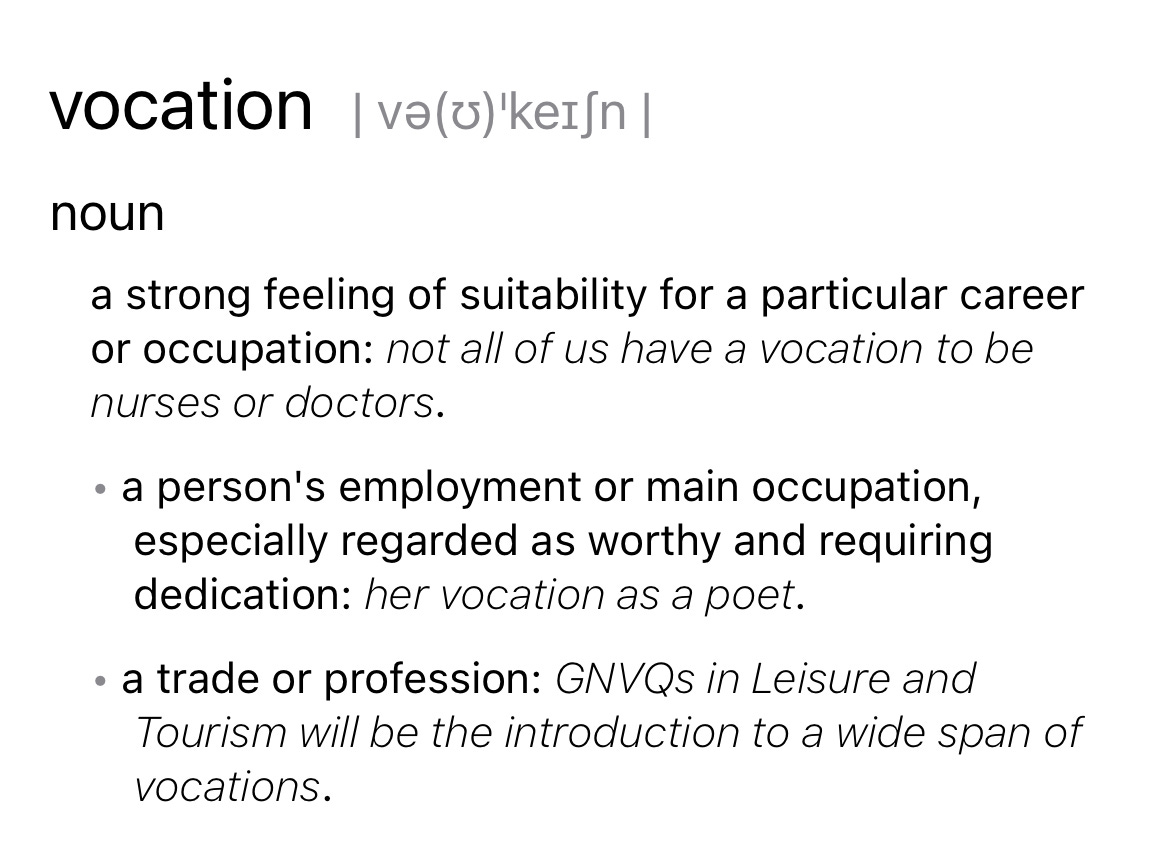
There’s an acknowledgement in the idea of vocation that this work is hard, the second definition of vocation according to Oxford Languages is ‘a person's employment or main occupation, especially regarded as worthy and requiring dedication’. The example they then use however is ‘her vocation as a poet’ which I am not sure I agree with as a poet myself. Writing poetry is not essentially viable as a means to earn a living. Poetry is a hobby of the part time insane.
Despite the acknowledgment that many front-facing public sector jobs are hard and require dedication, we do not remunerate the work that is often the hardest. You can see evidence of this in the disparity between different public sector workers pay. Teachers earn more than nurses. This is likely an historical hangover from when nursing was a predominantly female profession. It might also be seen as a preference to value intellectual professions, to consider them to be harder and therefore deserving of more pay. Whilst nursing has been a regulated profession in the UK since 1919 with the establishment of the Royal College of Nursing (which now functions as the nurses’ trade union), it was not until more recent decades that nurses were given more equal professional autonomy in more intellectual medical decision making for example. The primary function of a nurse, was to nurture. It is not coincidental that another meaning of the verb ‘to nurse’, is to breastfeed a baby. Nursing was seen to be about care.
On the contrary, whilst teaching done well does indeed require a great deal of care, this has only really been acknowledged in the secondary sector in the UK since the second half of the twentieth century. And that’s a generous timeline. Even then, it is not an idea that has taken great hold in the UK; favouring, as we do, a system that seeks to essentially brutalise children into a state of passive submission or else exclude them from society. The Scandinavian system rests much more on holistic principals of caring for and educating young people. I have no evidence for this statement but my own first hand experience of Scandinavian people suggests that they are a great deal more chill than your average British person. It’s a system I prefer.
We pay teachers more than nurses in the UK, ergo the caring elements of front facing public sector jobs are those for which you are paid the least; ergo we don’t value care as a society. It’s an unspoken truth, the evidence for which can be quite easily found in a comparison of the current pay across the public sector. We do really value qualifications however, especially ones that require a lot of study. My teaching job is a combination of thinking and care. The hardest bits of my job are certainly not the ones for which I was required to go to university. The undervaluing of the labour of care in monetary terms is something that I have never really been able to wrap my head around.
It seems to me that in all jobs you do a bit of thinking and a bit of doing and what differs between jobs is the proportion between the two; more thinking equals more money. It’s not in all jobs that you do a bit of caring however. And this part seems to be completely unpaid. Possibly people don’t really understand how or why caring for others is hard because they have never had to really do it. In contrast, some people have to care for other people from a really young age. It is often the latter that are attracted to and make their way into caring professions. I keep reading and hearing of a fish joke in books and podcasts but it is a useful analogy and I am going to be lazy and use it. I might have even read the joke linked to caring. I think this is Gabor Maté’s idea. I have found a version attributed to a writer called David Foster Wallace on the goodreads website to use here. I am not going to pretend that I have read any David Foster Wallace or know anything about him:
‘There are these two young fish swimming along and they happen to meet an older fish swimming the other way, who nods at them and says "Morning, boys. How's the water?" And the two young fish swim on for a bit, and then eventually one of them looks over at the other and goes "What the hell is water?’
Many people in caring professions do not register how hard caring is because caring is their normal, the environment they have always existed in just as a fish has always existed in water. Maybe this is why they only demand more pay and recognition for it about once a decade through striking. Caring is hard though. It is physically and emotionally hard. There’s a reason why we have a recruitment crisis in teaching and the NHS. It’s because these jobs are hard. They take a lot out of you. If you as a citizen want decent public sector services then you want public sector professionals that still have the physical and emotional capacity to care. We could do that by valuing them a bit more. I don’t understand why we don’t.
Valuing public sector workers doesn’t just mean paying them more money. We could also start treating them a bit better. We could let them have things like a lunch hour because in your average day a public sector worker is dealing with a lot. Very often public sector workers are part of someone else’s really stressful life event. Public sector workers are present and often participating in events that might transpire to be defining in the life, self or psyche of another human being. Surely we can recognise that is a pretty big deal? They are there for your trauma; they are there for your joy. Surely it’s a good thing for society that we give them as good a shot as possible of handling these important moments in people’s lives well by ensuring they are not hungry, they are not dehydrated, they are not exhausted.
This isn’t hyperbole. It’s pretty standard across your public services that staff are working in under resourced provision where ten years of cuts has meant they are being asked to deliver the same service with less resources. The biggest and often unseen cost of cuts to public services is two sided;
Heads: the physical and emotional exhaustion of public sector workers
Tails: the subsequently substandard provision often received by citizens.
Giving public sector workers better pay and conditions will surely result in better services for all? I cannot understood why people who use services would not support better working conditions for the people providing them. Maybe they don’t know what the job looks like. I am going to describe it in as factual a way as I can.
Front facing public sector work in 2023 feels relentless to do well. It is long hours at an emotional intensity which is exhausting. It is constant scrutiny. It is a sector whose workers are so undervalued they are often made to feel guilty for things like taking breaks. Most public sector facilities are not nice places to work. They have heating and ventilation systems that do not work well so it can be 30 degrees in parts of buildings in summer and 10 degrees in winter. These conditions make care more difficult. Nobody is in a good mood when they are too hot or too cold.
Public sector workers often have a workload that is too large to complete within the confines of a 40 hour working week. Some of this workload is administrative work that you can get into a lot of trouble if you do not complete because public sector work involves a lot of responsibility for others and therefore is subject to a great deal of scrutiny. You must evidence your work as well as do your work. If you are someone who cares about doing your job well, the almost impossibility to do so without sacrificing all other elements of your self and life or feeling guilty for not doing so can take a toll on you over time. There are fewer and fewer older teachers around now because they burn out quicker. It’s a big emotional load to carry that pressure and guilt. It is almost commonly accepted that most people will not carrying on doing frontline public sector work into their fifties. It is almost a physical impossibility given the intensity of the jobs involved and the emotional headspace it requires.
Maybe we could improve the lives of public sector workers by acknowledging that whilst their jobs are vocations involving dedication and commitment, we could probably reduce the levels of dedication and commitment that we expect by making their day to day lives a bit nicer. Letting them have a break, allowing them the satisfaction of being able to deliver good services in a standard working week, not constantly using pernicious messaging and media to make it out like they are lazy pieces of shit. Maybe we could create pay and working conditions that allow public sector workers the luxury of avoiding absolute burnout. Maybe we could give them the privilege of being able to say, ‘it’s not a just a vocation, it’s job’.
Trust me when I tell you. You are losing very good people
.
My favourite phrase - "more thinking equals more money". The luxury of being able to think rather than do also affords much better pay.